How Sitcom Characters Create Comedy: Beyond Favorite Quotes
A critical framework for character writing, ensemble balance and performance, with contrasting readings of Chandler Bing and Phil Dunphy.
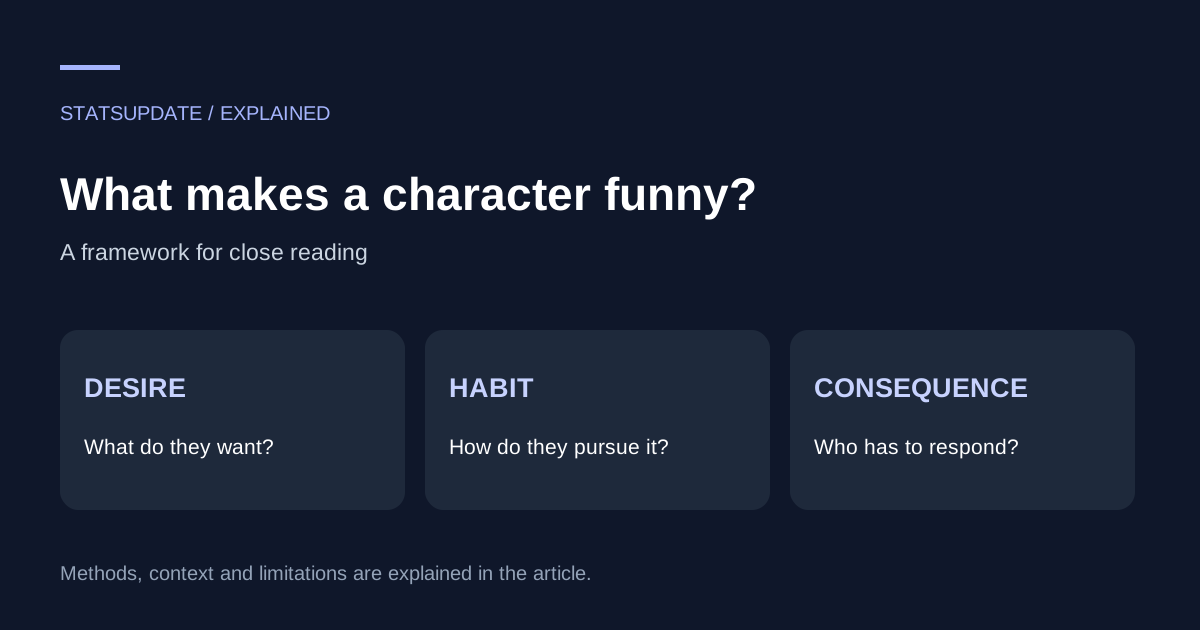
A favorite sitcom character can feel easy to identify and surprisingly difficult to explain. We remember a facial expression, an awkward pause or a line we repeat with friends. Yet a character who produces the funniest isolated clip is not necessarily the person who makes a full episode work. Comedy also depends on partners, recurring expectations and consequences that make the next scene possible.
This is a critical framework, not a survey or a statistical ranking. It offers a way to discuss character writing without presenting personal taste as a universal fact. It also explains why our separate essays on Chandler Bing and Phil Dunphy can favor different comic strengths without needing identical arguments.
A comic engine is a repeatable source of trouble
Start by identifying what a character wants and how they habitually pursue it. A character who wants admiration might exaggerate a small achievement. Someone who wants control might make an elaborate plan for a simple dinner. The audience anticipates friction between the desire and the method. That friction can generate many stories without requiring the character to become a different person each week.
The useful question is not simply whether a character is “relatable.” Ask what their defining behavior does to a scene. Does it delay a confession, turn a practical task into a competition, or make another person explain something they would rather conceal? A strong answer describes an action. A weak answer lists attractive qualities that could fit almost anyone in the cast.
Chandler: language as protection
One way to read Chandler is that verbal wit protects him from exposure. A joke lets him participate in a difficult conversation while avoiding its emotional center. This makes timing important: the interruption or qualification can reveal what he does not want to say directly. The humor is not just a supply of clever lines; it can dramatize reluctance.
That interpretation has limits. Not every Chandler joke needs a psychological explanation, and a sitcom also needs quick laughs between plot developments. A useful essay distinguishes a repeated character pattern from a claim about every moment. The strongest evidence is a scene in which removing the joke would change how the relationship is understood, rather than merely shorten the conversation.
Phil: confidence colliding with perception
Phil offers a different critical route. His enthusiasm can create a gap between the role he imagines himself playing and the role others see. The pleasure is often watching commitment outlast evidence. A small demonstration becomes a performance because he believes it deserves an audience. The scene can remain affectionate even while exposing a mistake.
The important distinction is between sincerity and competence. A character can mean well and still cause work for other people. Analysis becomes richer when it notices that cost. If an essay praises optimism without considering the family members who handle its consequences, it risks describing a motivational poster instead of a person in an ensemble comedy.
The straight person is doing comic work
A joke needs someone to receive it. The listener can sharpen it through disbelief, patience, irritation or a refusal to acknowledge its premise. That response establishes the social stakes. A character who appears less flamboyant may be making the most conspicuous character funny by giving the audience a stable point of comparison.
Try reviewing a scene twice. On the first pass, follow the speaker. On the second, watch the person who is not talking. Notice when an expression changes, when a reply is withheld, or when a practical action continues despite the distraction. This simple viewing exercise often changes a ranking because it reveals contribution that a quotation-based list cannot capture.
Rhythm is more than speed
Fast dialogue can be exhilarating, but speed alone does not create rhythm. Comedy also depends on the space before a response and on whether the audience has enough time to anticipate the wrong outcome. An immediate answer can puncture pretension; a delayed answer can make the listener's discomfort the joke. The same words can serve different purposes depending on placement.
When describing performance, use observable details. Say that a character resumes a task before answering, corrects a phrase halfway through, or looks toward another person before committing to a claim. These descriptions are more useful than calling an actor's timing “perfect.” They also give readers a reason to revisit a scene and test the interpretation themselves.
Ensemble balance changes what “best” means
Imagine removing your favorite character from an episode. Which scenes would lose their conflict? Which relationships would become redundant? Which remaining character would need to take over the missing function? This thought experiment distinguishes personal affection from structural importance. A favorite may be the best source of surprise while another character holds the story together.
An ensemble also benefits from contrast across episodes. A person who is sensible in one situation can be unreasonable in another without becoming inconsistent, provided the change follows recognizable priorities. The question is whether the audience understands the trigger. A rigid ranking may overlook this flexibility because it treats each character as a fixed collection of traits rather than part of an evolving network.
Growth should preserve the source of comedy
Long-running sitcoms face a tension: viewers want familiar pleasures and also want relationships to matter. If nobody learns anything, emotional developments can feel disposable. If everyone solves their defining problem, the original source of conflict may disappear. A satisfying change often alters what a character is willing to risk while leaving their recognizable way of speaking and reacting intact.
For a character essay, compare a recurring behavior before and after a meaningful relationship change. Does the behavior now serve someone else, or does the person catch themselves repeating it? Avoid claiming that one touching scene cancels years of contrary behavior. Growth is more persuasive when the episode acknowledges the difficulty of changing rather than announcing that the problem has vanished.
Awards and popularity answer different questions
Awards records can document recognition, and audience polls can document the preferences of the people who answered them. Neither directly proves that a character is best written. The Television Academy is a primary source for award information, but a critical argument still needs evidence from the program. Recognition and interpretation should not be collapsed into one claim.
The same caution applies to social clips. A moment can circulate widely because it is short, self-contained or easy to caption. That tells us something about how it travels online, not necessarily how it functions inside an episode. A quiet scene that completes a season-long relationship may be less shareable and more dramatically important.
Build an argument another viewer can disagree with
Choose three criteria before writing: perhaps comic rhythm, contribution to the ensemble and believable development. Give one concrete observation for each, then include a limitation. Another viewer can reasonably weight those criteria differently. That disagreement is the point of criticism: a clearer account of what each person values, rather than a false verdict that ends the conversation.
Use the framework when exploring our sitcom selection or after trying a television quiz. The quiz tests recall; the analysis asks what those remembered moments accomplish. Keeping those activities distinct gives both a purpose and makes a return to a familiar show more rewarding.