How to Compare Films Without Confusing Popularity and Quality
A practical film-selection framework that separates performance, genre, box office, ratings and personal taste.
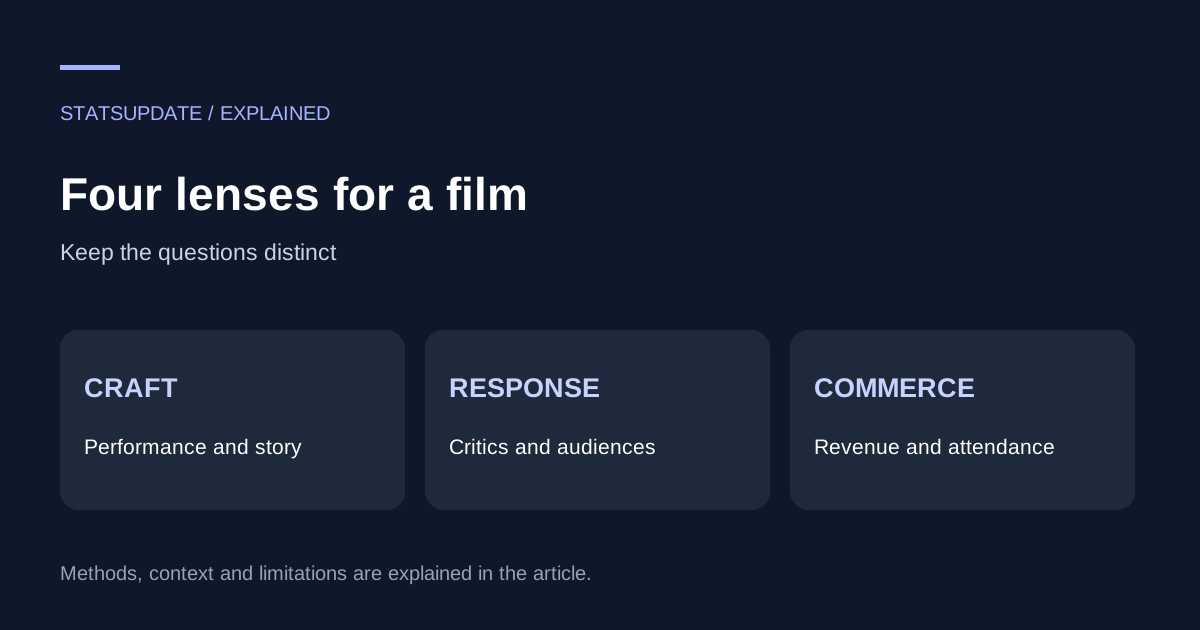
A film can earn a large audience, receive strong reviews and remain personally unappealing to a particular viewer. Another can become someone's favorite despite modest commercial performance. Those outcomes do not contradict each other. They describe different relationships between a work, its distribution, its audience and the criteria people bring to it.
This guide offers a practical method for building and reading film lists. It is an editorial framework, not a new box-office dataset or a claim that taste can be reduced to a formula. Use it alongside our Shah Rukh Khan film selection to understand why performance, storytelling, genre and cultural memory can lead to different recommendations.
Decide what the list is for
A list for a first-time viewer should behave differently from a retrospective for a longtime fan. The newcomer needs accessible entry points, a sense of genre and a warning about major tonal differences. The fan may value an overlooked performance or a film that challenges an established screen persona. A single ordered list cannot serve every purpose equally well.
Write the purpose in one sentence before selecting titles. For example: “These films introduce the range of an actor's work without requiring knowledge of earlier roles.” That sentence gives the list an organizing principle. If a choice cannot be explained in relation to that purpose, either the choice or the stated purpose needs revision.
Separate performance from the surrounding film
An actor can be compelling in a film with uneven pacing or an unconvincing resolution. Conversely, a highly effective film may use a deliberately restrained performance that does not produce many showreel moments. A useful review distinguishes what the performer contributes from what the screenplay, editing, music and supporting cast accomplish together.
Look at a scene where the character must change tactics. Does the performance show a shift in confidence, concealment or attention? Describe what changes rather than merely calling the acting powerful. Then ask whether the scene's staging gives the actor an opportunity to communicate that shift. The answer keeps performance criticism connected to the collaborative nature of filmmaking.
Judge a genre by its promises
A romantic comedy, a thriller and a social drama ask for different kinds of engagement. Suspense may depend on withheld information; comedy may depend on repetition with variation; melodrama may give emotional expression a scale that would feel excessive elsewhere. A film can succeed on its own terms while failing to provide the experience a particular viewer wanted.
This does not mean that genre excuses weak writing. It means the criticism should identify the promise before evaluating its delivery. Does the thriller's reveal follow from earlier evidence? Does the comedy develop its relationships between jokes? Does the drama earn a heightened emotional moment through the choices that precede it? These are more precise questions than whether a film feels realistic in every scene.
Box office measures transactions under conditions
Revenue depends on ticket prices, release scale, territory, time in theaters and reporting conventions. It should not be treated as a direct count of viewers or a self-contained measure of artistic quality. Even two genuine grosses can be difficult to compare when one is domestic and the other worldwide, or when one includes a rerelease and the other does not.
For an invented example, Film A sells one million tickets at an average of ten currency units, while Film B sells 1.5 million at six. A earns ten million and B earns nine million, although B sells more tickets. The example does not model any actual release. It simply shows why a revenue ranking and an attendance ranking can answer different questions.
Historical comparison needs restraint
Inflation adjustments can improve one part of a comparison while leaving other differences unresolved. Screen availability, population, leisure habits, competing media and distribution practices also change. A modern release and an older release did not compete under identical conditions. Adjusting money alone does not make the rest of those conditions disappear.
If reliable admissions are unavailable, avoid pretending to reconstruct them from a rough ticket-price guess. State the limitation and use another form of evidence: documented release history, contemporary reviews, later critical discussion or a careful account of the film's formal qualities. A missing number is preferable to a confident calculation whose inputs cannot be checked.
Ratings depend on who participates
An audience rating reflects the people who chose to submit a rating on a particular platform under that platform's rules. It is not a random sample of everyone who saw the film. A critic score similarly depends on the included reviewers and the method used to combine their judgments. Read the definition before comparing scores across services.
Also distinguish the share of positive reviews from the average strength of those reviews. A film that many reviewers find mildly enjoyable can perform well on a positive-review percentage, while another divides viewers between admiration and dislike. Those patterns suggest different viewing experiences. The percentage alone does not tell you which one will suit your preferences.
Build a recommendation around tradeoffs
A helpful recommendation tells the reader both why to watch and what may not work for them. A film might offer an expressive central performance but require patience with a long first act. Another might deliver tightly controlled suspense while providing less emotional warmth. Naming those tradeoffs respects the reader's agency and avoids treating every entry as an interchangeable masterpiece.
Use comparisons carefully. Saying that two films both feature romance is less useful than explaining how they handle the lovers' conflicting obligations. Saying that one performance is more restrained gives the reader a meaningful expectation when you identify the behavior being restrained. The purpose is to help someone choose, not to decorate a list with stronger adjectives.
Spoilers are an editorial choice
An introductory viewing guide should usually describe the premise and the kind of experience offered without revealing the resolution. A close analysis may need to discuss the ending because it changes the meaning of earlier scenes. Both approaches are legitimate when the reader knows which one they are entering.
Place a spoiler notice before detailed plot discussion rather than after it. When linking between a recommendation and an analysis, identify the difference in the link text. This is a simple way to make a film archive useful to people at different stages: deciding what to watch, reflecting after watching, or returning to compare performances across an actor's career.
A defensible list leaves room for disagreement
Choose a small set of criteria, explain how they relate to the list's purpose, and support each selection with a distinct observation. Do not assign decimal scores unless there is a real measurement process behind them. A numerical appearance of precision can make a subjective judgment less transparent rather than more rigorous.
For factual release and credit information, use a film's official credits or an identifiable catalog such as the British Film Institute's collections resources. For interpretation, show your reasoning and let readers disagree. Our pop-culture archive brings those activities together: factual details make the discussion checkable, while criticism explains why a work might matter to a particular viewer.